An archive of development, as of 1 November 2026. The latest development build is
experimental; it may differ from the public game.
The version timeline
Every numbered release recorded in the changelog, plus the documented experimental series
through 0.11.3.6. Open a version to explore what it introduced, how it improved the engine
or game, and why those changes mattered.
Browse all 84 versions
0.1 / Project foundations
0.1.0 · Engine + foundations
The first commit
On 17 September 2026, Lowfi Engine began as a repository and a development workflow,
before it had a world to render.
Explore the changes and improvements
What changed
Strict TypeScript and Vite provided a typed application with a development
server and hot reload; gl-matrix supplied vector and matrix operations.
The engine and game lived in separate directories from the start, with import
aliases for both. This established the boundary between reusable systems and the
example game.
ESLint, Prettier, editor settings and Git hooks made formatting, type checks and
commit conventions part of normal development. Git LFS handled source assets.
Why it mattered
This was the base that later rendering, physics and gameplay could grow on without
putting every system into one application file.
0.1.1 · Engine + foundations
Tests before the world
The project added executable checks while the engine was still small, rather than
waiting for a complete game.
Explore the changes and improvements
What changed
Vitest introduced repeatable unit tests and a watch mode. Early cases covered
gl-matrix basics and the planned weapon time-to-kill calculation.
GitHub Actions ran linting, formatting, type checks, tests and a build for
pushes and pull requests.
A local check command reproduced the continuous integration pipeline. Pre-commit
checks ran tests related to the files being changed.
Why it mattered
An intended rule could now become a test before a visible feature existed. A
working demo alone would no longer be the only evidence that a change was correct.
0.1.2 · Engine + foundations
A heartbeat and three states
A fixed-step simulation loop and a state machine gave the demo its first runtime
structure.
Explore the changes and improvements
What changed
Simulation advanced at a fixed step while rendering used an interpolation factor
between steps. Catch-up work was capped to prevent an overloaded frame from
creating endless extra work.
The state machine declared transitions between menu, playing and paused.
State-scoped listeners could be cancelled when leaving a state.
Rate counters exposed runtime activity, while the demo showed simulation and
render frequencies. A favicon gave the page its first small visual identity.
Why it mattered
Separating simulation time from display refresh was foundational for later physics
and networking. Menu and pause behaviour also became explicit state transitions.
0.1.3 · Engine + foundations
The first automated web releases
The built application gained an automated path to the web after its checks passed.
Explore the changes and improvements
What changed
Cloudflare Pages deployment was connected to successful continuous integration,
with a production address and branch previews.
The production build was opened in a headless-browser smoke test, checking the
packaged application rather than only the source files.
Cache headers were shipped with the page, and a commit identifier was injected
into the build and displayed in the demo.
Why it mattered
A bug report could identify the deployed revision, and the version people opened
online could be checked as an actual build.
0.2 / First pixels and experiments
0.2.0 · Engine + foundations
The first triangle
The first visible rendering milestone was a coloured triangle rotating in a WebGL2
canvas.
Explore the changes and improvements
What changed
WebGL2 context creation included a readable explanation when the browser or
graphics driver could not provide it.
The viewport followed the canvas display size and device pixel ratio, with a cap
on rendering density and an updated aspect ratio.
Shader compilation reported readable GLSL errors. The triangle rotated only
while playing, with its rendered angle interpolated between simulation steps.
Why it mattered
This joined the earlier loop and state machine to a real graphics pipeline:
resizing, shader failures and paused rendering were observable behaviours.
0.2.1 · Engine + foundations
A first-person view into 3D
A perspective camera and physical-key input turned the flat triangle demo into a space
that could be explored.
Explore the changes and improvements
What changed
The camera supported yaw and limited pitch. Horizontal movement stayed
horizontal even while looking up or down.
Keyboard state used physical key positions and released held keys when focus was
lost. Pointer lock provided mouse-look with filtering for abnormal input jumps.
The scene contained a grid floor, boxes and the rotating triangle. Losing
pointer lock paused the demo instead of letting it keep moving unattended.
Why it mattered
There was now a first-person frame of reference for judging scale, movement and
later collision. The earlier triangle remained in the 3D scene rather than
disappearing from the project.
0.2.2 · Engine + foundations
The project starts telling its story
Development gained a public place for discussion alongside the private code
repository.
Explore the changes and improvements
What changed
A community discussion forum provided a place for questions, feedback and
development updates.
The first devlog introduced the project outside the source tree, creating the
beginning of a public development record.
Forum buttons in the demo menu and pause screen connected the running
application to that community.
Why it mattered
This step was about making the project followable and giving feedback a
destination. It did not add a new rendering or multiplayer system.
0.2.3 · Engine + foundations
Before multiplayer: a network experiment
A disposable test page investigated peer connections before networking was built into
the game.
Explore the changes and improvements
What changed
The prototype compared Trystero torrent and Nostr signalling strategies rather
than assuming one would work reliably everywhere.
It measured connection establishment, ping, throughput, packet loss and the kind
of route between peers, and produced a report that could be copied.
The network experiment used the separate strategy packages, allowing the project
to test how peers found each other independently of gameplay.
Why it mattered
The later room system had evidence to work from. A connection on one local network
was distinguished from a real route between different networks.
0.2.4 · Engine + foundations
Seeing how the demo runs
An on-demand overlay made the runtime inspectable before the renderer grew more
complex.
Explore the changes and improvements
What changed
The overlay displayed frame timing, CPU cost, draw calls, geometry counts,
simulation rate, missed frames and graphics hardware information.
A frame-time graph made occasional slow frames visible rather than hiding them
inside an average.
Frame statistics and a draw-call counter were hooked into the loop. The overlay
was loaded only when requested, and the status line updated less frequently.
Why it mattered
Later optimisation work could ask which part of the runtime cost time instead of
treating every slowdown as a rendering problem.
0.3 / Rendering
0.3.0 · Engine + foundations
A reusable rendering pipeline
The demo moved from one-off drawing code to reusable GPU resources, meshes and shader
programs.
Explore the changes and improvements
What changed
RenderDevice owned the WebGL2 context and tracked resources so they could be
recreated after context loss.
ShaderProgram introduced typed uniform updates and checked declared uniform
types when linking programs.
Mesh and MeshBuilder provided validated geometry and reusable GPU buffers. The
demo reused a cube mesh with different transforms and colours.
Why it mattered
Drawing an object became a combination of shared geometry, a shader and object
data. Context recovery became a responsibility of the engine instead of a page
reload.
0.3.1 · Engine + foundations
Textures and linear colour
Textured surfaces replaced the bare grid and established a consistent approach to
colour.
Explore the changes and improvements
What changed
Texture loading gained mipmaps, filtering presets, anisotropy, wrapping and
explicit sRGB or linear interpretation.
Shader includes introduced reusable colour-space functions. Texture colour was
decoded before lighting calculations and converted for display afterward.
A generated metre-grid texture made surface scale and UV orientation visible.
Runtime presets let the demo compare filtering choices.
Why it mattered
Texture detail now had a physical scale, and later lighting could operate on
linear values rather than multiplying display-encoded colours.
0.3.2 · Engine + foundations
Light, materials and tone mapping
The scene gained a lighting model with ambient illumination, sunlight and local
lights.
Explore the changes and improvements
What changed
Hemispherical ambient light distinguished sky and ground contributions. A
directional sun and point lights added diffuse and normalised Blinn-Phong
specular lighting.
Point lights had bounded influence and distance attenuation. The engine selected
useful lights for the scene and uploaded their data through array uniforms.
ACES tone mapping handled bright overlapping illumination. A day/night toggle
and orbiting coloured lights made the differences visible in the demo.
Why it mattered
The renderer could describe shape through lighting rather than colour alone, while
controlling highlights that would otherwise clip to flat white.
0.3.3 · Engine + foundations
A sky around the world
A cubemap sky replaced the empty background and connected the scene to a day or night
environment.
Explore the changes and improvements
What changed
Cube textures validated matching square faces, supported mipmaps and sRGB, and
participated in GPU resource restoration.
The sky renderer used camera orientation without camera translation, so looking
around changed the view while walking did not move the sky closer.
Generated day and night skies included clouds, sun, stars and moon. Their
conventions were shared with the scripts that produced the images.
Why it mattered
The scene acquired an environment beyond its geometry. Sky imagery and lighting
could be compared together instead of feeling like unrelated background and
foreground.
0.3.4 · Engine + foundations
Sun shadows
Directional shadow mapping added the first explicit relationship between occluding
geometry and light.
Explore the changes and improvements
What changed
A depth pass from the sun supplied a shadow map, sampled through hardware
comparison and a PCF filtering kernel.
The shadow region followed the camera and aligned to texels to reduce visible
movement in the shadow pattern.
Slope bias and normal offsets addressed self-shadowing artefacts. Shadow
resources were recreated after context loss, and the demo exposed a shadow
toggle.
Why it mattered
Objects could cast shadows on other surfaces, improving contact and scale. The
implementation also established the shadow pass used by later scene and animation
features.
0.4 / Scenes and assets
0.4.0 · Engine + foundations
Objects become a scene graph
A hierarchy of scene nodes replaced an unstructured set of object transforms.
Explore the changes and improvements
What changed
Nodes combined translation, quaternion rotation and scale, and inherited their
world transform from a parent.
Dirty tracking recalculated only affected branches. Traversal, searching,
visibility, reparenting and cycle prevention made the hierarchy usable as an
engine system.
The demo used nested pivots and arms to animate objects at several levels,
showing local and inherited motion together.
Why it mattered
Complex objects could be assembled from parts and moved as a unit. This was the
structural base for imported models, articulated characters and map content.
0.4.2 · Engine + foundations
Models arrive through glTF
A custom glTF loader connected Blender-produced assets to the browser renderer.
Explore the changes and improvements
What changed
The parser handled glTF and GLB containers, scene nodes, buffers, vertex
attributes, materials, textures and several accessor layouts.
GPU geometry was uploaded once and could be instantiated into separate scene
hierarchies. Asset failures identified the file involved.
A scripted Blender streetlamp exercised hierarchy, mirrored nodes, materials and
different normal styles. Asset budgets became executable checks.
Why it mattered
The engine could consume authored content instead of building every visible object
as a procedural cube.
0.4.3 · Engine + foundations
Do not draw what cannot be seen
Frustum culling used object bounds to avoid submitting geometry outside the useful
view.
Explore the changes and improvements
What changed
Meshes gained CPU-side axis-aligned bounds, transformed conservatively into
world space, including negative scales.
Frustum planes came from the view-projection matrix. Point and box tests
determined whether an object could contribute to the image.
The main and shadow passes used different relevant volumes: an off-camera object
could still cast an on-camera shadow.
Why it mattered
Visibility became a decision made before sending geometry to the GPU, without
incorrectly discarding shadow casters.
0.4.4 · Engine + foundations
Shared materials and fewer state changes
The renderer began organising work by shared appearance rather than repeating material
setup for every object.
Explore the changes and improvements
What changed
Materials carried colour, textures, specular response, emission, face settings
and UV behaviour, with an identity suitable for sorting.
MeshRenderer sorted visible draws by material. Object transforms still changed
per draw, while repeated material state could be sent once.
Uniform, texture-binding and face-state caches avoided redundant WebGL calls.
Counters exposed the effect rather than only the final frame rate.
Why it mattered
This reduced repeated CPU-side setup while retaining the same scene. It
complemented culling: one removes unnecessary draws, the other makes required
draws less repetitive.
0.5 / Physics
0.5.0 · Engine + foundations
Rapier gives the world a physical counterpart
The engine gained a fixed-step WebAssembly physics world with bodies, colliders and
queries.
Explore the changes and improvements
What changed
Rapier was loaded on demand. Dynamic, fixed and kinematic bodies supported
primitive colliders, triangle meshes and ray tests.
Body operations included velocity, impulses, forces, teleporting and kinematic
targets. Rendering interpolated body poses between physics steps.
Static collision meshes could be generated from the same geometry that was
drawn. The demo became a sandbox with throwable and falling cubes.
Why it mattered
Visible scenery could now stop or move physical objects, and the later character
controller had a world to query.
0.5.1 · Engine + foundations
The camera gains a colliding body
A kinematic capsule controller turned free-flying camera movement into grounded
movement through obstacles.
Explore the changes and improvements
What changed
A swept capsule computed allowed displacement each fixed step. It handled
gravity, jumping, floor contact and wall contact.
Autostep, ground snapping and optional wall sliding addressed common cases when
moving through level geometry.
The demo could switch between walking and flying, with the camera following an
interpolated capsule when walking.
Why it mattered
A player could be tested against the physical space instead of moving an eye point
through walls.
0.5.2 · Engine + foundations
Walking slopes instead of hovering above them
Ground movement gained explicit rules for inclines, steep surfaces and contact
recovery.
Explore the changes and improvements
What changed
Desired movement was projected onto the ground plane to maintain sensible speed
when climbing or descending.
The controller exposed slope and ground-normal information, combining contact
detection with a downward query where appropriate.
Steep surfaces stopped counting as walkable ground: falling speed accumulated
along them and jumping was refused.
Why it mattered
The difference between a staircase, a ramp and a slideable slope became a physical
rule rather than an accidental camera motion.
0.6 / Engine systems
0.6.0 · Engine + foundations
Actions replace hard-coded keys
Input moved behind an action map, separating what the game asks for from which
physical key performs it.
Explore the changes and improvements
What changed
Actions could have several bindings, and configuration validation recovered
individual bad entries rather than rejecting all controls.
Defaults, shipped configuration, saved rebindings and URL overrides formed
distinct layers. Sensitivity, inverted look and raw mouse input were
configurable.
Displayed instructions came from active bindings. One action dispatcher replaced
separate hard-coded toggle handlers.
Why it mattered
Controls could be changed without rewriting movement and UI code, and the
interface could describe the controls the player actually used.
0.6.1 · Engine + foundations
Sound enters the scene
A reusable audio system connected the listener and positional sounds to the world.
Explore the changes and improvements
What changed
Audio unlocked after a user gesture, with master volume, mute and a listener
following the camera.
Positional playback used distance attenuation and panning. The engine could both
load sound files and synthesise tones and noise.
The demo gained a sound beacon, distance-based footsteps and impacts when
throwing cubes. Its status explained why audio might be silent.
Why it mattered
Position could be communicated through hearing as well as graphics. Browser
autoplay restrictions became a handled state rather than an unexplained failure.
0.6.2 · Engine + foundations
Debug tools, a temporary menu and parkour
The demo gained tools for understanding the world and a first dedicated movement
course.
Explore the changes and improvements
What changed
Wireframe, collider and culling views made three different descriptions of the
same scene inspectable.
An in-game console supported commands such as teleporting, changing maps and
rebinding actions, with history and completion.
A temporary Demo / Parkour / Forum menu exposed the new content. Platform
spacing came from movement formulas rather than unrelated hand-tuned distances.
Why it mattered
The project could investigate collision and navigation problems in the running
application, and movement had a practical course to test.
0.6.3 · Engine + foundations
Skeletal animation and GPU skinning
Animated glTF models gained a complete path from sampled clips to deformed geometry
and shadows.
Explore the changes and improvements
What changed
Skin joints, weights and inverse bind matrices were loaded with translation,
rotation and scale animation channels.
Clip sampling supported several interpolation modes, while playback exposed
looping, speed, reverse playback and scrubbing.
GPU skinning had a corresponding shadow variant, so an animated body cast an
animated shadow. The parkour course also expanded into a longer timed route.
Why it mattered
Animation became an engine capability that game characters and viewmodels could
share.
0.6.4 · Engine + foundations
Particles without an object per particle
A bounded particle system introduced smoke, sparks and the reusable effects needed for
later combat.
Explore the changes and improvements
What changed
A pool stored particle properties in preallocated typed arrays. Removing a
particle reused its slot instead of building a new chain of objects.
Emitters supported continuous rates, bursts, cones, drag, gravity and changes of
size and colour over a particle lifetime.
Instanced camera-facing quads rendered each effect, with depth testing and
optional additive blending. A full pool refused new particles and counted the
refusals.
Why it mattered
Effects gained a predictable memory and rendering structure. They could be reused
later for muzzle flashes and impacts without inventing another system.
0.6.5 · Engine + foundations
A hardware checkpoint
The project added a repeatable scene and measurement controls for discussing its
hardware demands.
Explore the changes and improvements
What changed
Render scaling separated the displayed canvas size from the resolution actually
drawn, making resolution a measurable quality lever.
A fixed benchmark scene combined geometry, lights, shadows, particles and
physics bodies rather than testing an empty frame.
GPU timing was separated from CPU loop timing, and the browser check exercised
combinations of rendering and throttling settings.
Why it mattered
Performance work had a defined workload and a way to distinguish a CPU limit from
a GPU limit.
0.6.6 · Engine + foundations
Optimisation checked against the image
Rendering work was reduced where the recorded benchmark showed a benefit, with image
comparison as a guard.
Explore the changes and improvements
What changed
Point-light selection moved to individual objects so surfaces did not evaluate
distant lights that could not affect them.
Some colour conversion work moved from fragment to vertex processing where this
preserved the intended output.
Texture filtering remained a quality lever. A depth prepass was implemented as
an experiment but left disabled when it made the measured scene slower.
Why it mattered
Optimisation was treated as a comparison with a control, including the possibility
that a plausible optimisation should not ship enabled.
0.6.7 · Engine + foundations
Loading before the first hitch
Preloading and quality presets moved expensive first-use work away from active play.
Explore the changes and improvements
What changed
A preloader ran named tasks with weighted progress, per-task timing and
independent failure handling.
Warm-up drew representative pipelines and advanced physics while loading, so
their first-use setup did not fall into the first ordinary frame.
Minimal, Standard and High presets combined measured controls such as
resolution, shadows, particles, filtering and light limits. The loop could
discard elapsed loading time instead of catching it all up.
Why it mattered
The loading screen became part of runtime preparation, rather than a label that
disappeared before expensive work actually began.
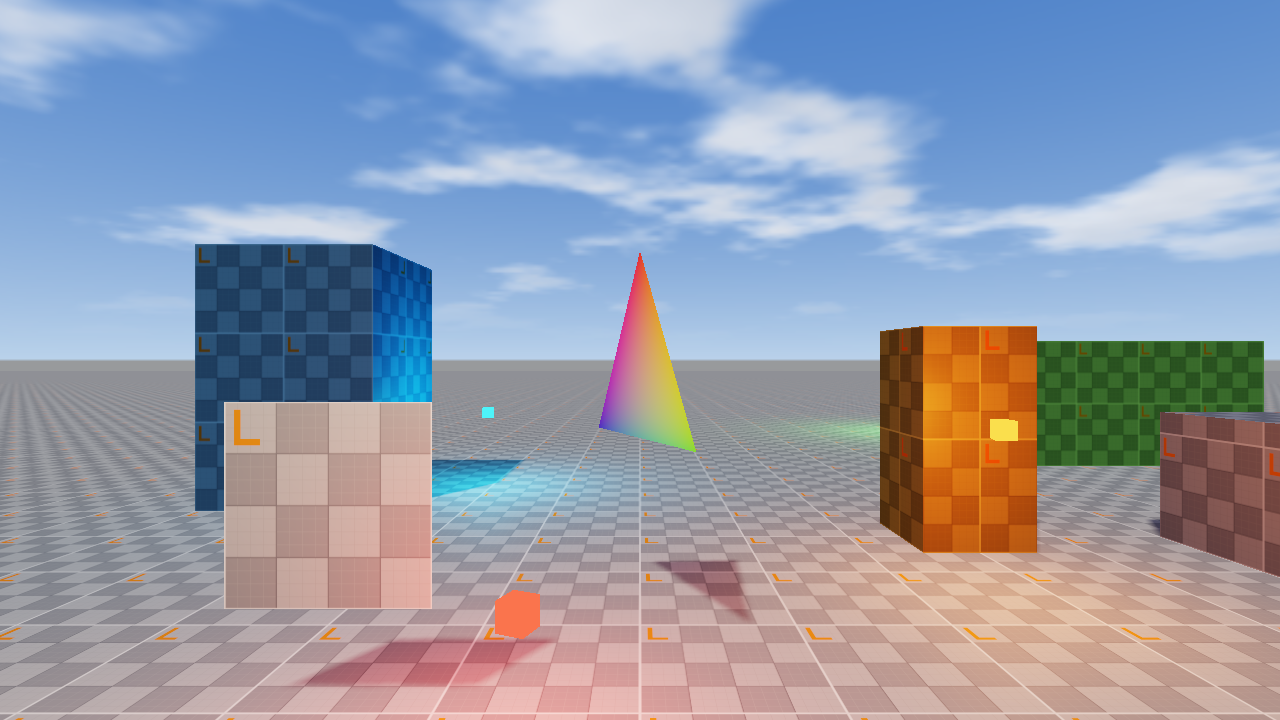
Archived engine test scene associated with the second devlog; the exact
screenshot build was not recorded.
Open original resolution
0.7 / First-person combat
0.7.0 · Game + engine
Arcade movement becomes a game system
Running, sprinting, crouching, sliding and mantling established the playable movement
layer above the capsule controller.
Explore the changes and improvements
What changed
Acceleration, friction and air control supplied distinct movement rules rather
than moving the camera at a constant speed.
Crouching and sliding changed the player state, while mantling handled a
reachable ledge as a deliberate action.
A greybox course and browser-driven key sequences exercised the same movement
that a player would use.
Why it mattered
The engine supplied physical collision; the game now supplied the feel and rules
for traversing it.
0.7.1 · Game + engine
The first weapons and a real shooting range
Two weapons turned movement through the greybox into an FPS combat prototype.
Explore the changes and improvements
What changed
The initial rifle and sidearm had fixed recoil patterns, ammunition, reloading,
automatic or semi-automatic fire and deterministic spread.
Hitscan originated at the eyes: the shot used the aim direction before recoil
moved the view. Weapon cadence advanced from scheduled fire times rather than
drifting with frames.
Practice targets measured time-to-kill inside the game. Mouse buttons became
bindable actions, and the page displayed aim and weapon state.
Why it mattered
Weapon rules could be exercised against targets rather than existing only as
numbers in a design table.
0.7.2 · Game + engine
Damage, death and respawning
Combat gained a player life cycle and a shared interpretation of hits.
Explore the changes and improvements
What changed
Damage zones distinguished head and body using the position of the hit on the
target body, including a crouched target.
PlayerLife controlled health, death and respawn, disabling movement and attacks
while dead.
Map bounds gave leaving the world the same death-and-return path as being shot.
The shooting range used player-shaped target regions.
Why it mattered
Death was no longer just a number reaching zero; the prototype could return a
player to play consistently.
0.7.3 · Game + engine
Combat becomes readable
Crosshair behaviour, hit confirmation, effects and sound began explaining what each
shot did.
Explore the changes and improvements
What changed
Crosshair spacing represented the actual projected spread cone, while recoil
affected a different part of the reticle.
Body, head and kill feedback used distinct hit markers. Tracers, muzzle flashes
and impact effects reused the particle system.
Combat sounds distinguished weapons and hit outcomes. Sliding was revised from
play feedback to be easier to trigger and clearer to see.
Why it mattered
The player gained visual and audible evidence of accuracy and damage instead of
having to infer everything from the target disappearing.
0.7.4 · Game + engine
An animated weapon in the player’s hands
A first-person viewmodel tied weapon state to visible motion.
Explore the changes and improvements
What changed
Procedural weapon parts formed the on-screen model, with a magazine that moved
during reload.
Idle, aim, reload and additive fire clips used the existing animation sampler.
Clip blending began from the displayed pose, allowing a transition to be
interrupted safely.
Aiming moved the weapon into position while narrowing the camera view. Pause
gained an explicit screen with resume and return-to-menu actions.
Why it mattered
Handling an action acquired a visible duration and state: a reload or an aiming
transition could be understood from the weapon itself.
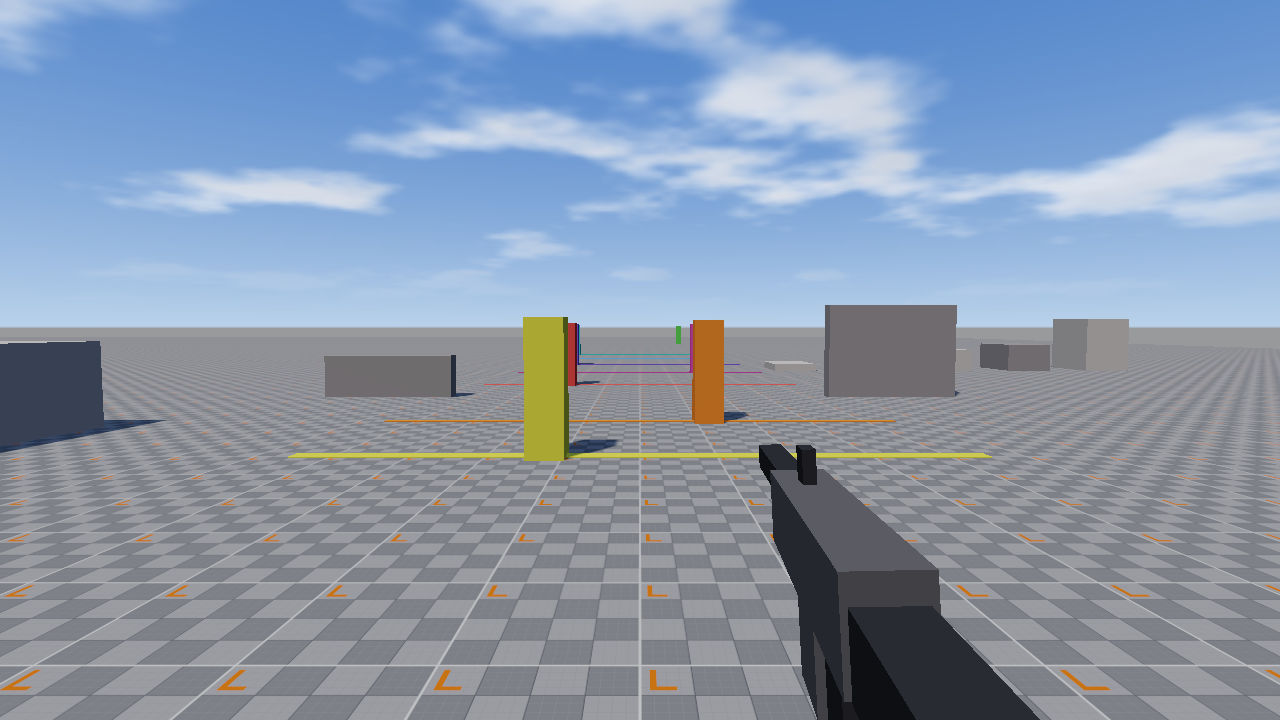
Archived range image associated with the third devlog; it illustrates the period
rather than every change in this release.
Open original resolution
0.7.5 · Game + engine
Tactical audio and distinct weapon silhouettes
Sound began conveying movement choices and obstruction, while each weapon gained its
own pose.
Explore the changes and improvements
What changed
Footstep audibility depended on movement style, using an attenuation rule that
actually reached silence at its intended range.
Walls reduced volume and removed high frequencies through an occlusion query and
low-pass filtering.
The sidearm gained a separate shape and aiming pose. Tracers and muzzle flashes
followed the animated muzzle of the held weapon rather than the screen centre.
Why it mattered
Players could reason about what others might hear, and shots visibly belonged to
the weapon being carried.
0.8 / Multiplayer
0.8.0 · Game + engine
Peers can find a room
The networking experiment became a usable connection flow between game clients.
Explore the changes and improvements
What changed
Short room codes and invitation links let one browser find another through
Trystero signalling.
A protocol version was separated from the application version, so cosmetic
patches did not automatically make peers incompatible.
The lobby reported connection progress and failure, offered retry, and
established one host identity for the session.
Why it mattered
The game gained a front door for multiplayer and a clear place to reject
incompatible messages before gameplay saw them.
0.8.1 · Game + engine
The host simulates the shared world
Connected browsers could see players moving through a world whose results were
computed by the host.
Explore the changes and improvements
What changed
Guests sent inputs, while the host moved their physical capsules through the
same movement system as its own player.
A shared binary schema described encoding and decoding. Messages had explicit
directions and did not let clients dictate health or match results.
Remote avatars initially used box bodies matching the player dimensions,
allowing the existing damage zones to apply.
Why it mattered
The authority boundary became concrete: a client requested an action, and the host
decided the resulting state.
0.8.2 · Game + engine
Move now, reconcile afterward
Client prediction reduced the delay between a guest pressing a movement key and seeing
movement.
Explore the changes and improvements
What changed
The guest simulated its own unacknowledged inputs immediately, then reconciled
them with the authoritative result.
Inputs were retained per fixed step and sent in batches, so the host could
reproduce their order rather than only receiving a recent direction.
A configurable artificial delay made local browser tests resemble a delayed
connection.
Why it mattered
Responsive local control no longer required waiting for a round trip, while the
host remained responsible for the accepted result.
0.8.3 · Game + engine
Smooth the other players
Remote entities gained buffered interpolation instead of jumping directly between
incoming states.
Explore the changes and improvements
What changed
Position and orientation were sampled slightly behind the newest network state,
allowing intermediate render frames to show continuous motion.
Limited extrapolation bridged a late packet before stopping rather than
inventing motion indefinitely.
Angles interpolated along the shorter rotation. Discrete states such as alive,
dead or crouched stayed discrete.
Why it mattered
Prediction helped the local player; interpolation addressed the different problem
of drawing everyone else between network ticks.
0.8.4 · Game + engine
Disconnections and background tabs
The session could react to departures and continue simulation when the host’s browser
lost the foreground.
Explore the changes and improvements
What changed
A deterministic host election used the remaining participants rather than
depending on a final transfer message from a departing host.
Notices explained player departure, host replacement and the end of an empty
match.
An Away state muted local sound without pausing everyone else. A
background-clock mechanism addressed browsers suspending animation callbacks in
hidden tabs.
Why it mattered
Losing focus or closing a tab became an explicit multiplayer event instead of an
unexplained frozen scene.
0.8.5 · Game + engine
Resolve the shot the shooter saw
Lag compensation connected authoritative hit detection to the delayed scene visible to
the shooter.
Explore the changes and improvements
What changed
The host retained a short history of player poses and rewound the target state
for a shot.
Health, death and respawn remained host decisions for both the guest and the
hosting player.
The host measured network timing and limited how far history could be used,
rather than accepting a client’s claimed hit as a result.
Why it mattered
A player could aim at the target on their screen rather than guessing where the
host had already moved it.
0.8.6 · Game + engine
A single validation gate
Incoming network messages gained a central boundary for validation and rate limits.
Explore the changes and improvements
What changed
The gate checked known message types, sender permissions, size and replay rules
before game code received a decoded value.
Token buckets limited each peer and message type without the burst loophole of
fixed time windows.
Typed violation reasons and a bounded log made rejected traffic inspectable. A
scripted hostile client and seeded fuzzer exercised the real gate.
Why it mattered
Future network defences could be added at one boundary instead of being scattered
across handlers.
0.9 / Maps and match flow
0.9.0 · Game + engine
A complete Team Deathmatch
The first structured multiplayer mode and Quartier gris turned the combat prototype
into a match that could be played to completion.
Explore the changes and improvements
What changed
Team Deathmatch tracked team kills, a score limit, a time limit and respawns as
rules separate from weapons and physics.
The host assigned arriving players to the smaller team. Blue and orange
whole-body colours made allegiance visible on the actual opponent.
Quartier gris introduced a street arena with routes and team spawns. Both
clients received the same match-end result from the host.
Why it mattered
Combat acquired a goal, opposing sides and an ending. The same mode interface
could later support other rules.
0.9.1 · Game + engine
A combat HUD and the start of localisation
The interface began presenting combat state as something readable while aiming.
Explore the changes and improvements
What changed
Health and ammunition used bars with supporting numbers, making changes visible
without requiring every value to be read.
A bounded killfeed displayed recent eliminations and team context. A smoothed
ping indicator reported connection timing.
An English dictionary and text lookup function moved interface wording out of
markup. Missing translations displayed their key instead of silently producing
blank space.
Why it mattered
The HUD became both a player-facing system and the first foundation for later
localisation.
0.9.2 · Game + engine
Ligne de crête, the first outdoor alternative
A longer arena introduced a ridge, side routes and a different distance profile from
the street map.
Explore the changes and improvements
What changed
The initial layout contrasted exposed longer sightlines with crossing routes and
positions at different heights.
Shared map-building helpers let a map use its own coordinates and be placed in
the world independently.
Common map tests covered every playable map. The welcome message named a map
using a short string rather than an index that would change whenever content was
added.
Why it mattered
Adding an arena became a content operation instead of automatically changing the
network protocol’s map list.
0.9.3 · Game + engine
Entrepôt, a close-range arena
The third map deliberately focused combat inside a compact warehouse.
Explore the changes and improvements
What changed
A single interior full of shelving created close corners instead of the ridge’s
long sightlines.
Starting positions were distributed around the edge, making direction and nearby
cover central to opening engagements.
Skylights admitted sunlight into the warehouse aisles, giving the initial
interior its lighting.
Why it mattered
The map set gained a close-range counterpoint to the existing outdoor layouts.
0.9.4 · Game + engine
Voie ferrée, a long narrow battlefield
The fourth layout explored combat along a linear rail yard.
Explore the changes and improvements
What changed
Teams started at opposite ends of an elongated arena, with platforms dividing
the overall length into sections.
Two flanks offered different exposure rather than making the full map one
uninterrupted firing lane.
Wagons broke the longest sightline, while passages between them required
crouching and made the rail side different from the slower, more obstructed
platform route.
Why it mattered
The four-map set now covered streets, terrain, a dense interior and a narrow
longitudinal arena.
0.9.5 · Game + engine
A lobby that can carry two matches
Profiles, readiness and a persistent room connected separate matches into a
multiplayer session.
Explore the changes and improvements
What changed
Player names had explicit allowed characters and length rules, and a default
identity let someone try the game before answering a profile prompt.
The lobby and results view shared one room: players could see teams, mark
readiness and continue without leaving the session.
Map rotation, invitation links and a rejoin action supported consecutive
matches. Profile and roster messages were sent when their data changed, not in
every simulation snapshot.
Why it mattered
The session became more than a single match followed by a dead end.
0.9.6 · Game + engine
A lightweight killcam
The game could show the moments before a death from the killer’s side.
Explore the changes and improvements
What changed
The replay used recent network states already received by clients, avoiding a
separate match-recording protocol.
Playback ran within the respawn interval rather than adding another waiting
period afterward. Players could skip it.
The reconstruction showed where participants were and looked, while
acknowledging that state snapshots did not contain exact weapon animation or aim
between ticks.
Why it mattered
A death could explain the opponent’s position without requiring a full replay
infrastructure.
0.9.7 · Game + engine
Keep a clip locally
The browser gained an optional rolling capture of recent canvas output.
Explore the changes and improvements
What changed
MediaRecorder captured the canvas into a local ring of recent video chunks.
The first capture action started recording; later actions saved a clip without
stopping the ring.
The video stayed on the player’s machine. The feature was opt-in because
capturing and encoding the canvas was real work.
Why it mattered
A player could save a moment for review or sharing without a game-owned upload
service.
0.9.8 · Game + engine
One loaded map, with its own light
Maps became independent scenes rather than accumulating together in the same runtime
world.
Explore the changes and improvements
What changed
Changing maps removed the old scene’s meshes and collision bodies. Sandbox
objects disappeared when a match arena was active.
Each map carried its own sky, sunlight, ambient light and lamps.
The warehouse became a night interior lit by suspended lights, replacing the
temporary reliance on daylight through roof openings.
Why it mattered
Content could set its own atmosphere, and a new map stopped paying for invisible
objects from every previous arena.
0.9.9 · Game + engine
Quartier gris becomes a modelled place
The street arena became the first full map produced through the Blender-to-glTF
pipeline.
Explore the changes and improvements
What changed
A code plan was exported for Blender, which generated a textured arena consumed
by the engine loader.
Three connected routes combined sheltered market spaces, a central square and a
higher walkway. Named places made the environment easier to describe.
Collision came from the drawn mesh, with the plan retained as the reference for
dimensions and route intent.
Why it mattered
The asset pipeline was demonstrated on an arena, rather than only on an isolated
prop.
0.9.10 · Game + engine
Ligne de crête becomes terrain
The ridge arena moved from stacked shapes to a sampled heightfield landscape.
Explore the changes and improvements
What changed
A rocky ridge, sunken paths and farms created a genuine
exposure-versus-travel-time choice.
The plan, Blender geometry and collider shared the same triangle layout rather
than comparing a smooth mathematical surface to a different triangulated floor.
An evening sky and aligned sunlight gave the ridge its own atmosphere. The
map-generation scripts were generalised to accept different map names.
Why it mattered
The terrain’s routes began behaving differently in play, not merely looking
different.
0.9.11 · Game + engine
Entrepôt becomes a lit interior
The warehouse received an authored model with repeated shelving and an inspected
lighting setup.
Explore the changes and improvements
What changed
Shelving bays reused shared glTF geometry through separate nodes, reducing
duplicated mesh storage.
A CPU light probe mirrored the renderer’s lighting calculations to inspect
player visibility around the floor.
The room gained its own indirect-colour approximation and hanging lighting,
while preserving the close-range layout.
Why it mattered
The engine demonstrated asset reuse and indoor content while exposing the
difference between a lit surface and a clearly distinguishable opponent.
0.9.11.1 · Game + engine
More coherent buildings and weapon handling
World presentation and first-person handling evolved together, with clearer
architecture and more expressive weapon motion.
Explore the changes and improvements
What changed
Quartier gris was reorganised into more coherent buildings while retaining its
route plan.
Weapons gained distinct parts and animations for magazines, moving actions,
empty reloads, drawing and pulling back from a wall.
A barrel-clearance query prevented a weapon embedded in geometry from firing.
The host independently refused a client that bypassed the local check.
Why it mattered
The update responded to what was actually visible and awkward in play, rather than
only to numerical map specifications.
0.9.12 · Game + engine
Voie ferrée becomes a dawn rail yard
The fourth arena completed the first modelled map set.
Explore the changes and improvements
What changed
Rails, wagons, platforms, halls and covered crossings defined two flanks with
different sightlines.
Repeated rail and wagon geometry shared storage through instances. The update
distinguished memory reuse from a reduction in draw calls.
A cold dawn sky and a revised retaining wall created the rail yard’s lighting
and horizon.
Why it mattered
The linear layout became a readable location, with repeated content and
map-specific light.
0.9.13 · Game + engine
Consistent arrivals and map transitions
Multiplayer placement gained a shared flow for arriving, respawning and following the
host to a different map.
Explore the changes and improvements
What changed
Guests followed the host’s map selection and loaded the destination world as
part of the session transition.
Player placement occurred after the destination geometry was available, with the
correct spawn and camera position.
Prediction history was reset across a relocation, keeping ongoing movement
aligned with the new world.
Why it mattered
The same room could move between arenas while keeping its participants together
and placing each player in the active world.
0.10 / Modes and the front end
0.10.0 · Game + engine
Zone Control
A second ruleset rewarded occupying space rather than only eliminating opponents.
Explore the changes and improvements
What changed
Teams captured points progressively, held them for score and contested them
through their physical presence.
The host decided point ownership and capture progress; guests supplied inputs
rather than claiming capture results.
Mode identity and compact point state were added to the network format, allowing
the lobby and HUD to describe the same match.
Why it mattered
The mode interface from Team Deathmatch supported another objective without
replacing weapons, physics or transport.
0.10.1 · Game + engine
Kill Confirmed
Eliminations created an opportunity to score rather than granting the point
immediately.
Explore the changes and improvements
What changed
A defeated player left a tag: the opposing team could confirm it for score,
while the victim’s team could deny it.
The host placed tags on actual ground and controlled their lifetime and
collection.
Snapshots carried tags and denial counters. Announcements followed state
changes, avoiding duplicate messages when state packets were missed.
Why it mattered
Movement after a fight became part of the scoring decision: securing or denying
the tag mattered as much as the shot.
0.10.2 · Game + engine
Free-for-all
A solo deathmatch ruleset removed teams and introduced an individual match result.
Explore the changes and improvements
What changed
Players could explicitly have no team, making opponent identification meaningful
without assigning everyone an artificial side.
The mode tracked kills and deaths per player and produced a deterministic
individual ranking.
Spawn selection considered exposure to living enemies and could use a
collision-probed pool of positions rather than only team endpoints.
Why it mattered
The game supported an individual match structure while retaining the same shared
simulation.
0.10.3 · Game + engine
Host-run stand-in players
Bots filled sessions using the same input and movement paths as human peers.
Explore the changes and improvements
What changed
The host filled requested player slots with bots and removed a bot when a human
needed the place.
Bot decisions received visible and audible perceptions instead of unrestricted
access to every opponent. The host rechecked line of sight when firing.
A collision-probed lattice and A* supplied routes; mode objectives selected
fights, capture points or visible tags. Difficulty changed reaction, aim and
turn behaviour.
Why it mattered
A single person could exercise the real multiplayer rules with opponents, while a
bot remained subject to the game’s action boundary.
0.10.3.1 · Game + engine
The V8 menu becomes the game’s front door
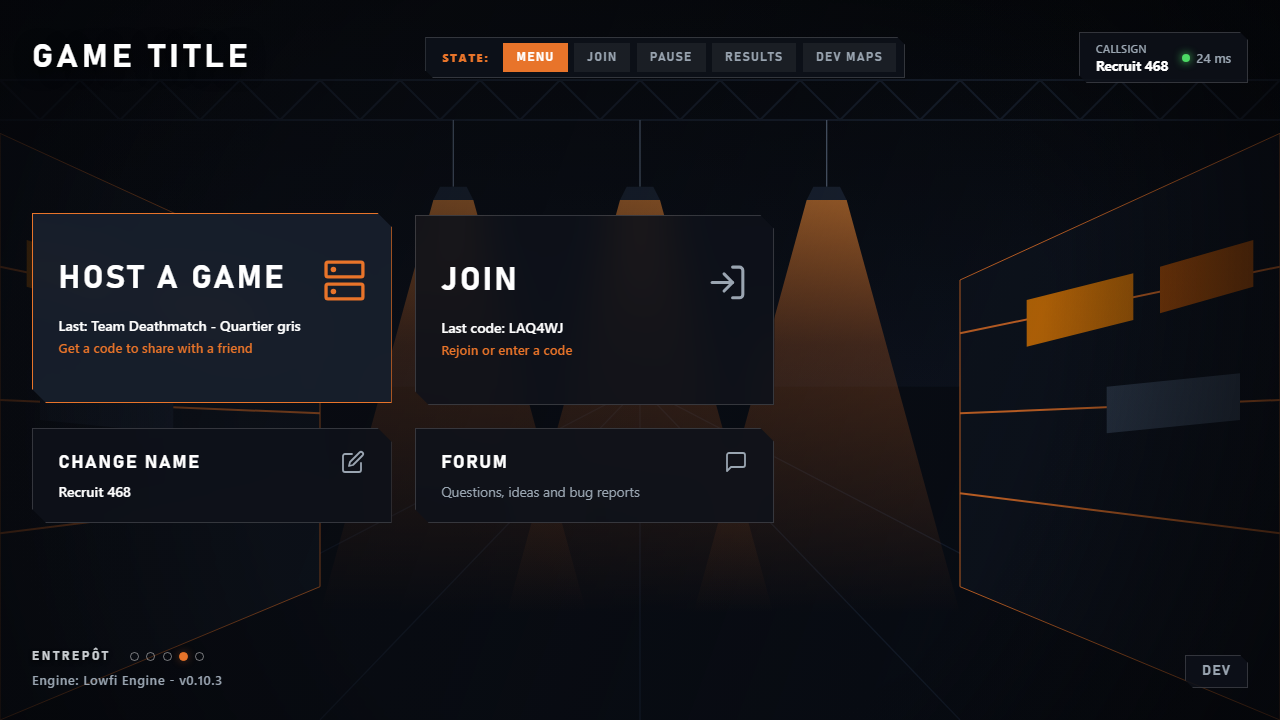
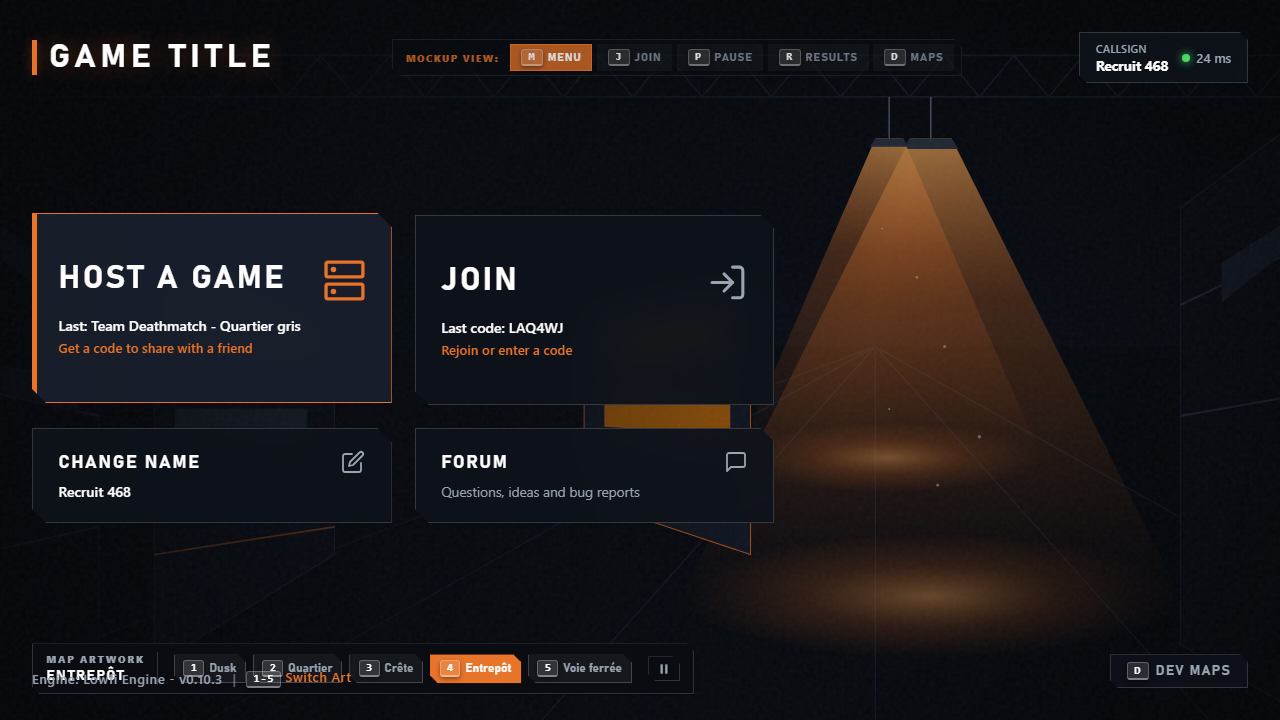
The temporary menu was replaced by the poster direction developed through the earlier
visual studies.
Explore the changes and improvements
What changed
Large Host and Join tiles led to room creation, rejoining and code entry.
Smaller actions handled the player name and community forum.
A screen state machine connected menu, loading, room, play and results. Static
illustrated backgrounds avoided running a 3D match behind the front end.
The developer drawer and debug controls became explicit options. The game still
used the temporary GAME TITLE label while the engine appeared as a credit.
Why it mattered
The application gained a deliberate route into a match and a visual identity
across its surrounding screens.
0.10.4 · Game + engine
Water is both a surface and a rule
The ridge gained water whose effects were shared by movement, weapons, sound and bots.
Explore the changes and improvements
What changed
Map plans described water volumes separately from solid geometry. Shallow wading
and deeper swimming had distinct movement rules.
Swimming stowed the weapon, added underwater visual and audio treatment, and
supported exits through banks or reachable ledges.
Water affected bullet travel, footstep audibility and bot route cost. A
lightweight rendering pass animated the surface with sky reflection and depth
tint.
Why it mattered
Water could no longer be a picture that the simulation ignored.
0.11 / Nexus and experimental development
0.11.0 · Game + engine
The arsenal grows, and the game is named Nexus
The example game received its own name while completing the first broader set of
weapon roles.
Explore the changes and improvements
What changed
An SMG, shotgun and scoped precision weapon joined the rifle and sidearm, with
separate handling, models and intended engagement ranges.
Damage falloff, pellet distribution, scope behaviour and loadout choices became
shared rules between the range and the host.
Nexus replaced GAME TITLE in the game interface. Lowfi Engine stayed the
engine’s name, displayed separately.
Why it mattered
The game’s identity and combat choices became distinct from the technology it
demonstrated.
0.11.0.1 · Game + engine
A revolver, a knife and a clearer in-match menu
Loadout selection and weapon switching became more visible and consistent.
Explore the changes and improvements
What changed
A revolver joined the primary choices, and a short-range knife could replace the
sidearm.
Primary and secondary selections appeared as separate controls in the room and
Escape menu. Wheel and keyboard actions switched between them.
Bots used the broader arsenal according to its firing and distance behaviour.
Loadout changes during play waited for the next life instead of granting fresh
ammunition immediately.
Why it mattered
Choosing equipment became an explicit interface action without turning a menu
visit into a combat reset.
0.11.1 · Game + engine
Grenades and tactical feedback
Combat gained physical thrown equipment and a more coherent HUD.
Explore the changes and improvements
What changed
Frag grenades bounced in the host’s physics world; smoke obstructed aimed sight
and bot vision; flash effects depended on whether the viewer could see the
burst.
Health, ammunition, loadout and equipment were regrouped, with match state above
the fight.
Connection failures distinguished unreachable peers, unavailable signalling and
stale pages, rather than waiting without a useful explanation.
Why it mattered
Equipment introduced decisions about cover and visibility, while the interface
made its state understandable.
0.11.1.1 · Game + engine
World-aware spawn placement
Spawn placement became a shared world-aware system, locating suitable ground and
checking the space a player needs.
Explore the changes and improvements
What changed
The map’s spawn coordinate became a starting suggestion: a world query located
the floor and checked room for the player capsule.
The host, guests and subsequent respawns used the same placement logic.
Free-for-all candidates that could not hold a body were excluded, and team spawn
orientation faced into the arena.
Why it mattered
Arrivals and respawns used the physical world itself to place the player, across
the host, guests and supported maps.
0.11.1.2 · Game + engine
Other players become people in motion
Multiplayer presentation gained articulated figures and shared weapon effects.
Explore the changes and improvements
What changed
Remote figures gained equipment, crouching, a gait driven by travelled ground
distance and a two-handed hold on the actual weapon.
Every remote shot carried visible and positional sound feedback, including
missed shots. Deaths fell to the ground instead of leaving a standing body.
Play now with bots started a session immediately. Respawns moved beyond fixed
team endpoints, equipment used cooldowns, and bots reacted to gunfire and raised
objectives.
Why it mattered
A match conveyed what other participants were doing instead of drawing only moving
damage boxes.
0.11.1.3 · Game + engine
Clearer team information and elevated objectives
Team identity and bot objectives became clearer across the match interface and the
playable space.
Explore the changes and improvements
What changed
Team colours carried consistently through scores, room lists, collected tags and
the killfeed.
Bots gained paths and objective handling for raised capture positions, including
the ridge bridge and other elevated platforms.
Join notices were positioned above the room panel, keeping the roster and its
text readable.
Why it mattered
Players could read team context across screens, while bots could participate in
objectives located above the main floor.
0.11.1.4 · Game + engine
A match that survives the room flow
The release added an in-match scoreboard and explicit rules for what happens when a
host leaves.
Explore the changes and improvements
What changed
Holding Tab showed players, teams, kills, deaths, ratio, ping, bots and the
match context.
A host option chose whether another player could continue the session after the
original host departed.
Normal play offered completed maps and kept developer controls behind the debug
path.
Why it mattered
The player-facing game flow became clearer, and host replacement became an
intentional session policy.
0.11.1.5 · Game + engine
Experimental builds identify themselves
A clear build channel and match-start countdown separated testing from normal release
play.
Explore the changes and improvements
What changed
A synchronised countdown held movement, shooting and throwing until the match
actually began.
Experimental builds displayed a persistent identifying banner and distinct menu
treatment. Work-in-progress maps were explicitly labelled experimental.
A debug report could export a readable session record with performance samples
and events. Completed maps’ obsolete box versions were retired.
Why it mattered
Players could recognise a test build and start together, while debugging gained a
shareable session artefact.
0.11.2 · Game + engine
Visible equipment variants and separate web identities
Weapons gained authored models and trade-off-based variants, while engine and game
addresses were separated.
Explore the changes and improvements
What changed
Optics, magazines and stocks changed handling through host-approved selections
applied between lives.
Blender models, textures and visible attachments brought those choices into
first- and third-person presentation.
Nexus used its own public and experimental sites; the former shared address
became the Lowfi Engine showcase. Weapon designations and nicknames were
updated.
Why it mattered
The game and engine could be presented independently, and loadout choices became
visible equipment rather than only statistics.
0.11.2.1 · Game + engine
A stable release assembled through seven betas
This release combined a richer armoury, loadout UI development and improved connection
choices; its Monastère layout remained experimental.
Explore the changes and improvements
What changed
Monastère introduced an experimental courtyard-and-crypt box plan. The burst
rifle Cadence and delayed-shot sidearm Crater broadened the weapon set.
Loadout selection gained a main-menu entry, 3D weapon previews, readable
trade-offs and separate primary/sidearm tabs.
MQTT replaced torrent as the alternate signalling strategy. Room-code copying,
adjustable reticle size and damage-scaled hit feedback improved everyday use.
Successive betas refined weapon models, smoke, grenade drawing and balance;
replay showed the historical positions of the world rather than a past camera
aimed at the present.
Why it mattered
The release brought weapon choices, equipment presentation and connection options
together through successive improvements.
0.11.2.2 · Experimental development
Serre’s water routes and movement-focused weapons
The experimental series added a greenhouse layout and weapons with distinct movement
trade-offs.
Explore the changes and improvements
What changed
The Serre box plan centred on a deep basin with swim, wade and dry routes, plus
raised capture positions.
Hover rewarded airborne and sliding play with an inverse spread rule, while
Swarm was a rapid sidearm that strongly punished firing on the move.
Attachments offered explicit capacity, sight or handling trade-offs rather than
a strictly better upgrade.
Why it mattered
The new arena reused water as a route decision, while the weapons asked players to
choose different movement habits.
0.11.2.3 · Experimental development
See through glass, fight around it
Labyrinthe introduced an experimental data-centre layout and a difference between
sight and physical passage.
Explore the changes and improvements
What changed
Server rows and perpendicular corridors surrounded a core behind
bullet-resistant glass, with separate offices and cooling areas.
The glass allowed vision and flashes while blocking players, bullets and
grenades. Bots could see through it without treating it as an open route.
Spike introduced visible travelling projectiles that could be dodged, while
Scrap added a compact two-barrel sidearm with a spread attack.
Why it mattered
A material could have different answers for visibility, collision and weapons, and
combat gained an alternative to immediate hitscan.
0.11.2.4 · Experimental development
Grue puts navigation on several floors
A dry dock and crane arena stressed movement, bots and weapon handling at different
heights.
Explore the changes and improvements
What changed
The box layout combined a dock floor, a quay and high crane structures connected
by stairs, narrow passages and suspended containers.
Surge added a held charge after an initial shot. Outlaw added a lever action,
per-round reload and limited penetration through marked thin cover.
Bot navigation retained several floors at the same horizontal position, checked
support near edges and kept objective heights meaningful.
Why it mattered
The arena exposed assumptions that worked on mostly flat maps but failed on stairs
and raised control points.
0.11.2.5 · Experimental development
Nuit Blanche, ground fog and suppression
The experimental game gained a foggy night arena and weapons built around control or
sustained fire.
Explore the changes and improvements
What changed
Height-dependent fog affected scenery, sky, water and glass. Bot visibility used
the same loss of transmission rather than seeing freely through the fog.
Nuit Blanche’s box plan placed a clear viaduct over a fog-filled park lit by
sodium-style lamps.
Snare slowed a target instead of killing it, while Bastion increased its firing
rate during sustained fire. Both gained models and attachment choices.
Why it mattered
Visibility and movement control became active parts of combat, instead of cosmetic
filters applied only to the player’s image.
0.11.3 · Experimental development
Gun Game
A new free-for-all mode made progression depend on changing weapons during a life.
Explore the changes and improvements
What changed
Each kill advanced the player through a weapon cycle, with the host granting the
new loaded weapon immediately.
A completed cycle ended the match; the HUD showed the current stage and leader
progress, and bots advanced through the same rules.
Gun Game used its own respawn and replay policy, while a loadout selected during
the match waited for another mode.
Why it mattered
The broader arsenal became the structure of a match rather than a choice made only
before spawning.
0.11.3.1 · Experimental development
Nexus V9 across menus and HUD
The interface was rebuilt as one experimental visual system instead of a set of
unrelated screens.
Explore the changes and improvements
What changed
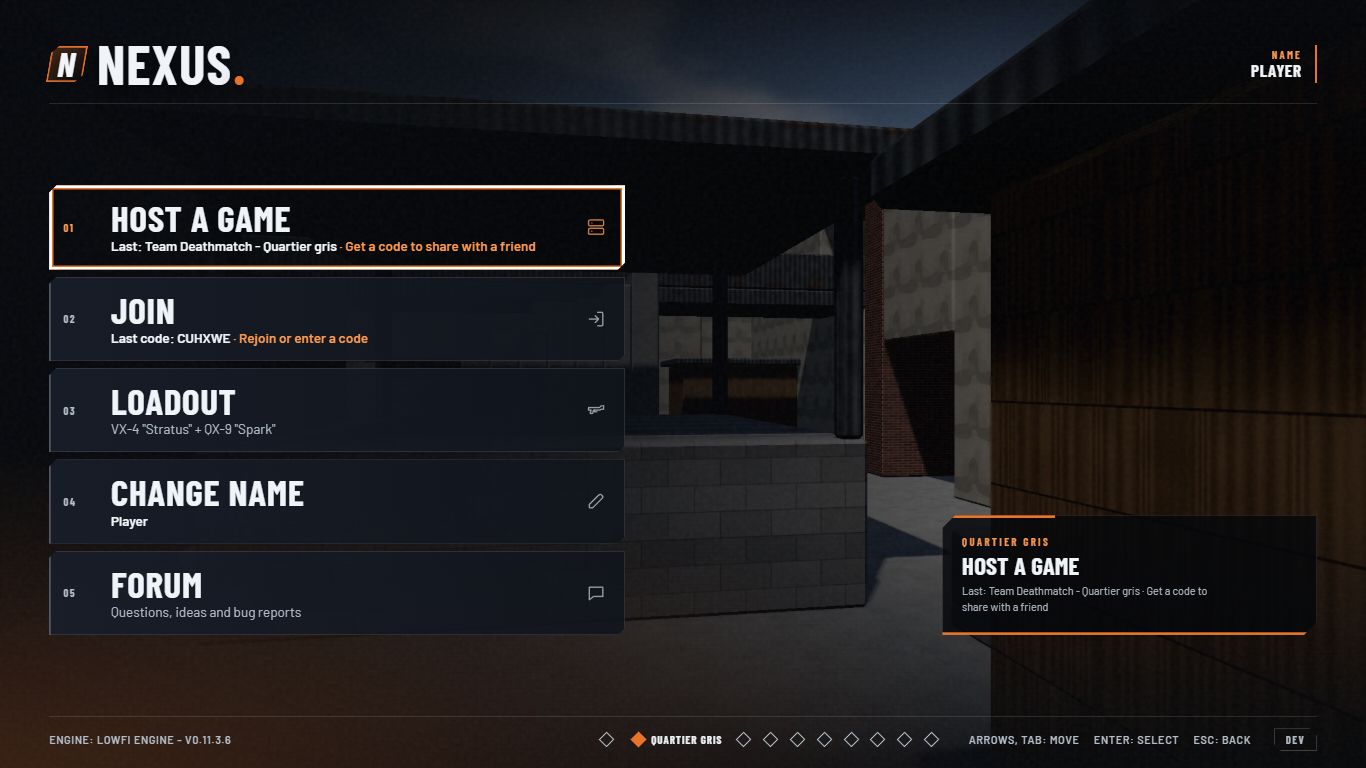
Condensed self-hosted type, dark surfaces, cut corners and team accents
connected menu, hosting, joining, loadout, room, loading and results.
Real map stills replaced most illustrated backgrounds. Keyboard navigation
followed the command stack, and equipment selection kept its own scrolling
column.
The HUD grouped health, ammunition and grenade icons, with team scores and
clearer objective states. Escape, Tab, killcam and countdown received the same
design language.
Why it mattered
The game acquired a coherent interface family, while existing game rules and
network behaviour remained outside the redesign’s intended scope.
0.11.3.2 · Experimental development
Monastère becomes stone, timber and winter light
The experimental monastery moved from a box plan to a modelled environment.
Explore the changes and improvements
What changed
Blender-built geometry introduced pale stone, frosted paving, columns, tombs and
timber while retaining the layout’s dimensions and objectives.
A winter-noon mountain sky placed a low sun over the courtyard and left colder
shade around the cloister.
The crypt relied on its own candle lighting rather than borrowing an outdoor
illumination pattern.
Why it mattered
The plan became a recognisable place without deliberately changing its movement
and capture structure.
0.11.3.3 · Experimental development
Serre becomes an abandoned greenhouse
The water-centred layout gained materials and an overhead structure that explained its
light.
Explore the changes and improvements
What changed
Concrete, mossy tile, pool mosaic and timber terraces gave the ground surfaces
distinct identities.
Reeds, hedges and beds preserved the blocking volumes used by the layout rather
than adding foliage that silently changed sightlines.
The broken greenhouse frame stood above the playable space, casting
late-afternoon stripes without closing the routes below.
Why it mattered
The model carried the original basin and route decisions into a more specific
environment.
0.11.3.4 · Experimental development
Labyrinthe becomes a data centre
The earlier server-maze plan received a modelled material and structural treatment.
Explore the changes and improvements
What changed
Perforated raised floors, acoustic walls, server racks, indicators and cooling
units made the interior readable as a data centre.
The central bullet-resistant glass retained its sight-versus-shot behaviour, now
framed by visible metalwork without deliberately narrowing doors.
The experimental batch added a night-vision visor for this arena, using a
rechargeable battery and an explicit HUD state.
Why it mattered
The visual environment became more descriptive while the existing glass and route
rules remained the basis of play.
0.11.3.5 · Experimental development
Grue becomes a working-scale dockyard
The multi-level box arena acquired its dock, crane and container identity.
Explore the changes and improvements
What changed
Tide-stained concrete, yellow crane surfaces, galvanised stairs, rusted
containers and timber supports replaced the plan’s generic blocks.
The model preserved the arena’s three movement levels, stair routes and elevated
capture objectives.
Marked thin panels retained their penetrable-cover role rather than becoming
visually similar but mechanically different scenery.
Why it mattered
The map’s material language and structures could explain the same vertical
decisions already present in the prototype.
0.11.3.6 · Experimental development
The current experimental snapshot
Nuit Blanche’s model and a further set of play-feedback changes completed the recorded
development series.
Explore the changes and improvements
What changed
The viaduct and park gained asphalt, paving, concrete, wrecks, kiosks and hedges
while retaining the fog and the bots’ corresponding sight rules.
A battery-limited thermal visor joined the night arena, showing warm bodies
through fog as a local visual tool.
Gun Game moved to a shuffled progression with two sidearm stages and a final
knife kill. The non-lethal Snare was excluded from the kill cycle.
The menu exposed more of its map background; joining codes used fixed-width
characters, and death/respawn feedback followed the player’s team colour.
Why it mattered
The latest snapshot combined five modelled arenas with refinements to the
interface and game modes informed by play feedback.
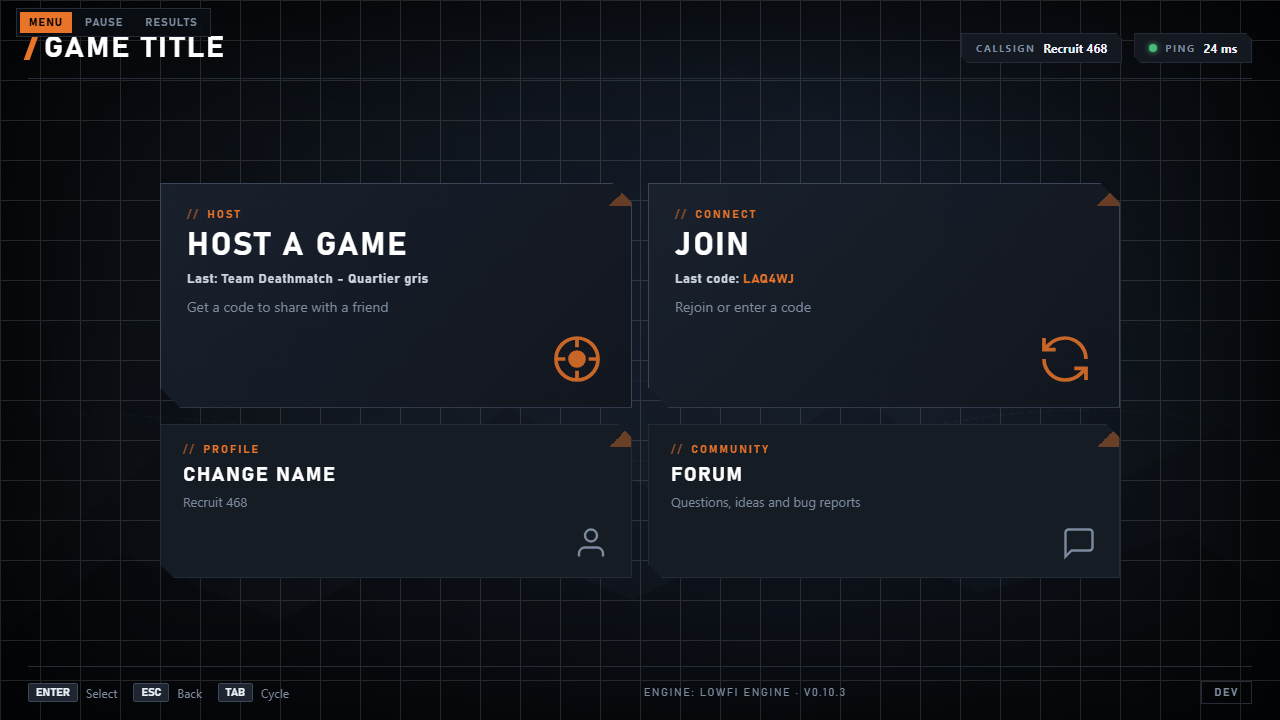
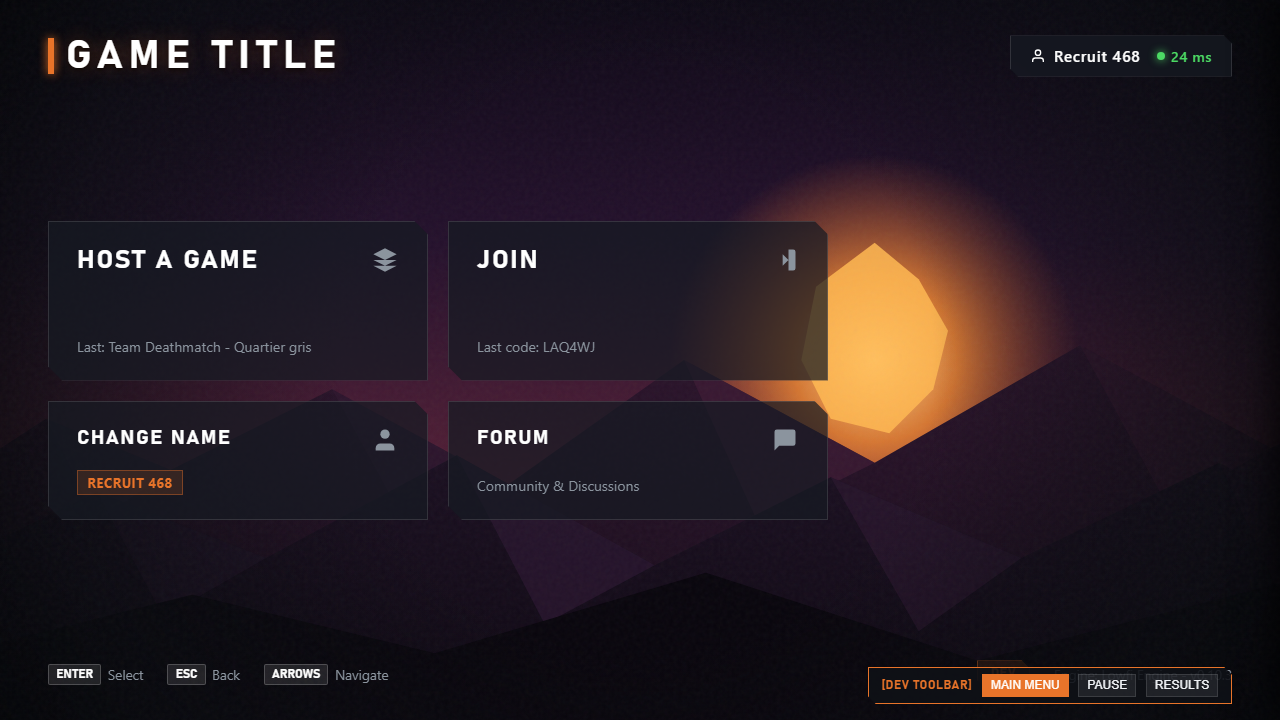
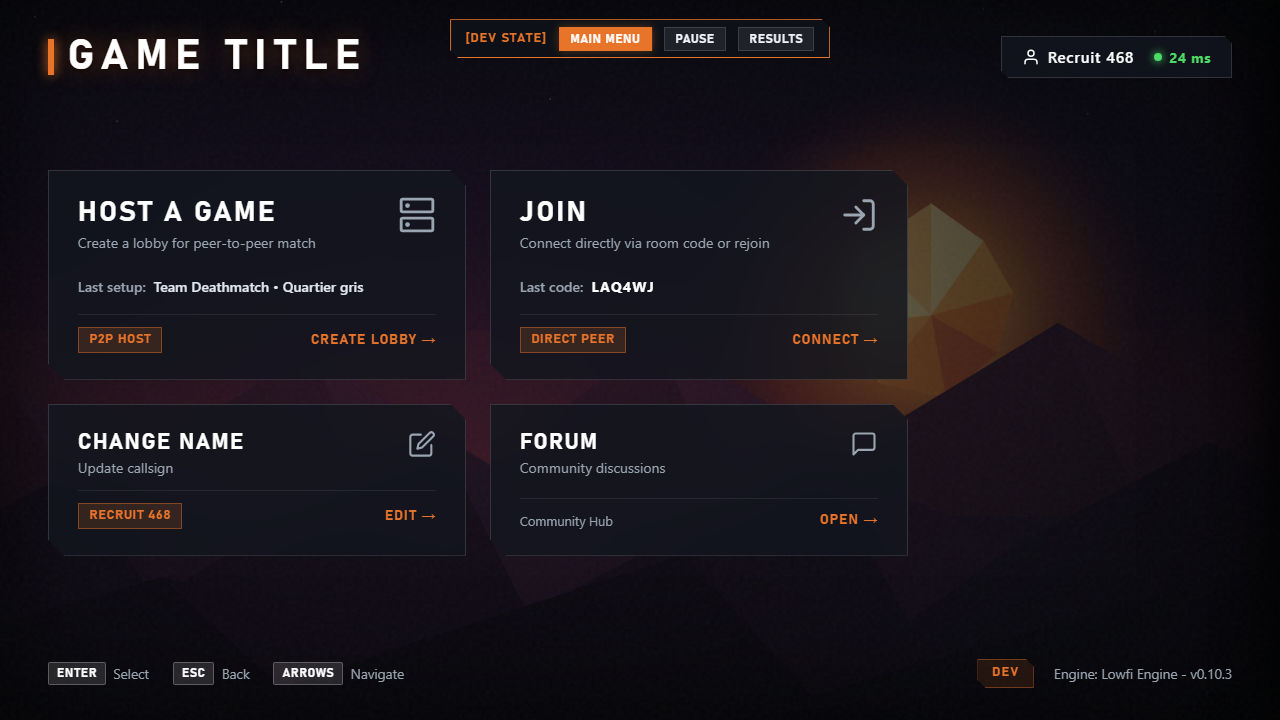
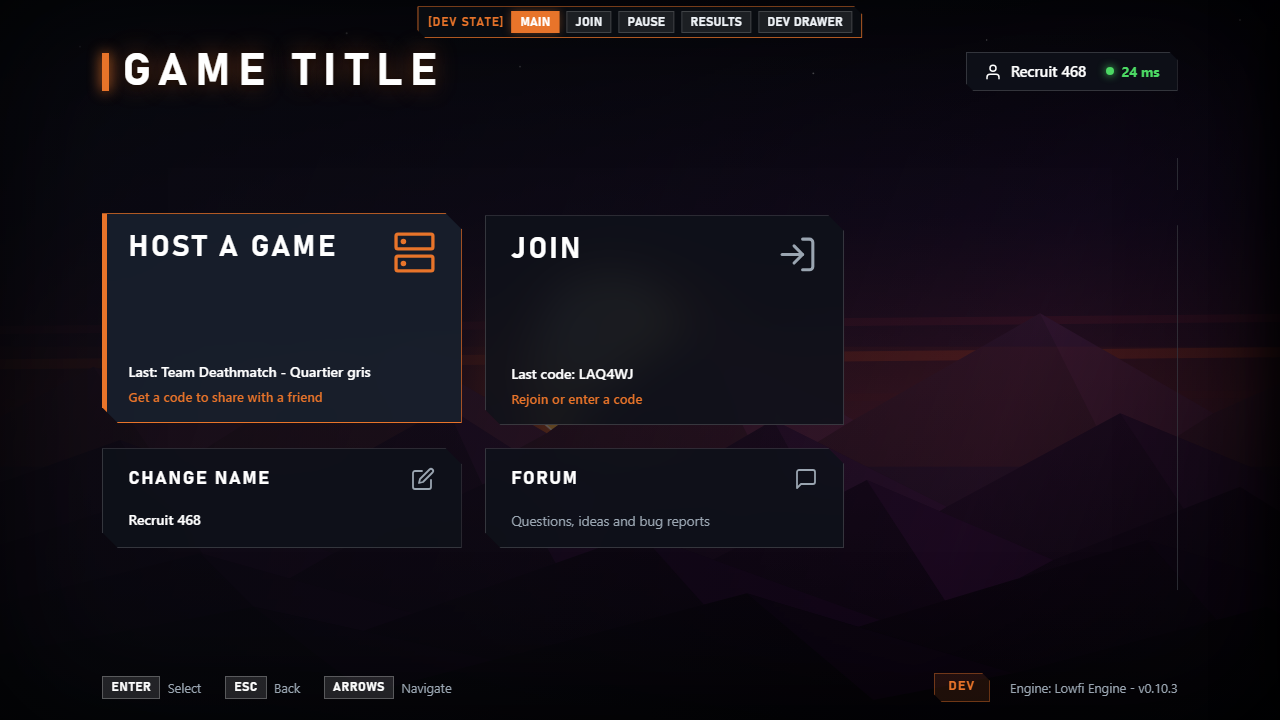
Menu V1 to V9
The route from a temporary menu to the Nexus interface. V1–V8 are design iterations around
the 0.10.3.1 menu project, not engine release numbers. The archive includes alternative
concepts; a study is not proof that a design shipped.
Before the visual studies
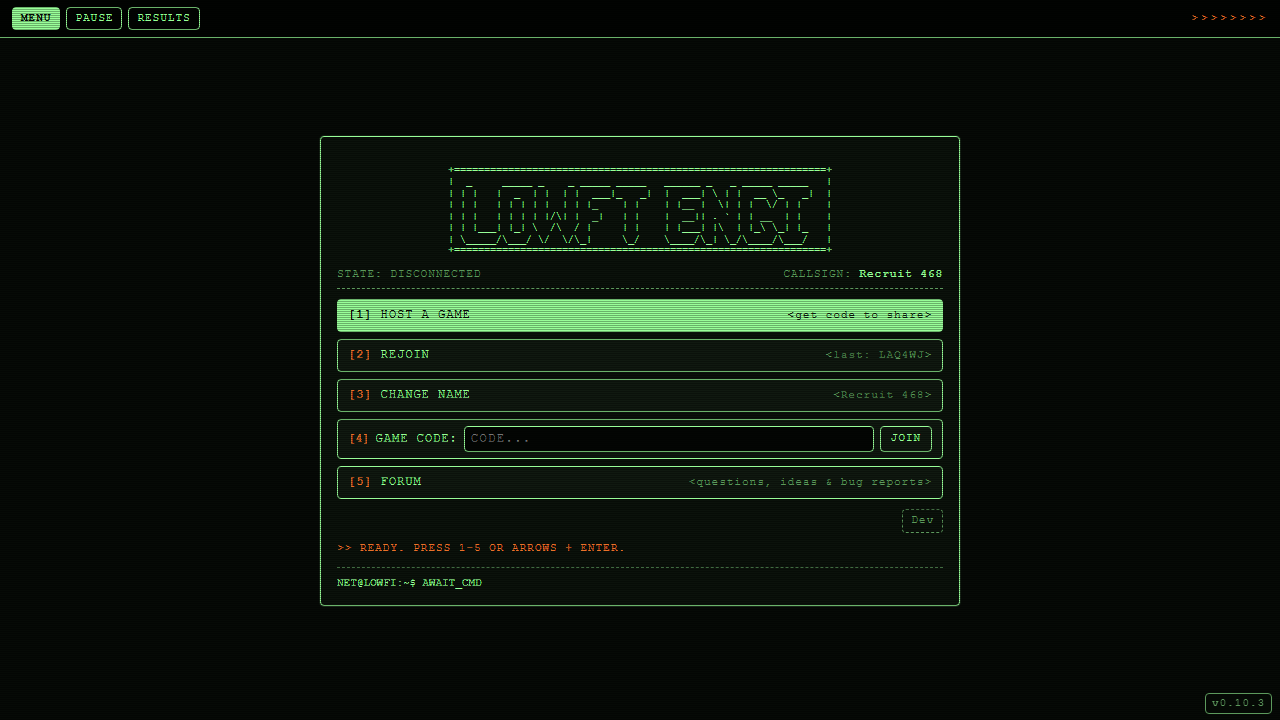
Version 0.6.2 used a temporary menu with Demo, Parkour and Forum buttons. The following
studies came later. V8 became the reference for the real 0.10.3.1 menu; V9 shows a
subsequent experimental game interface.
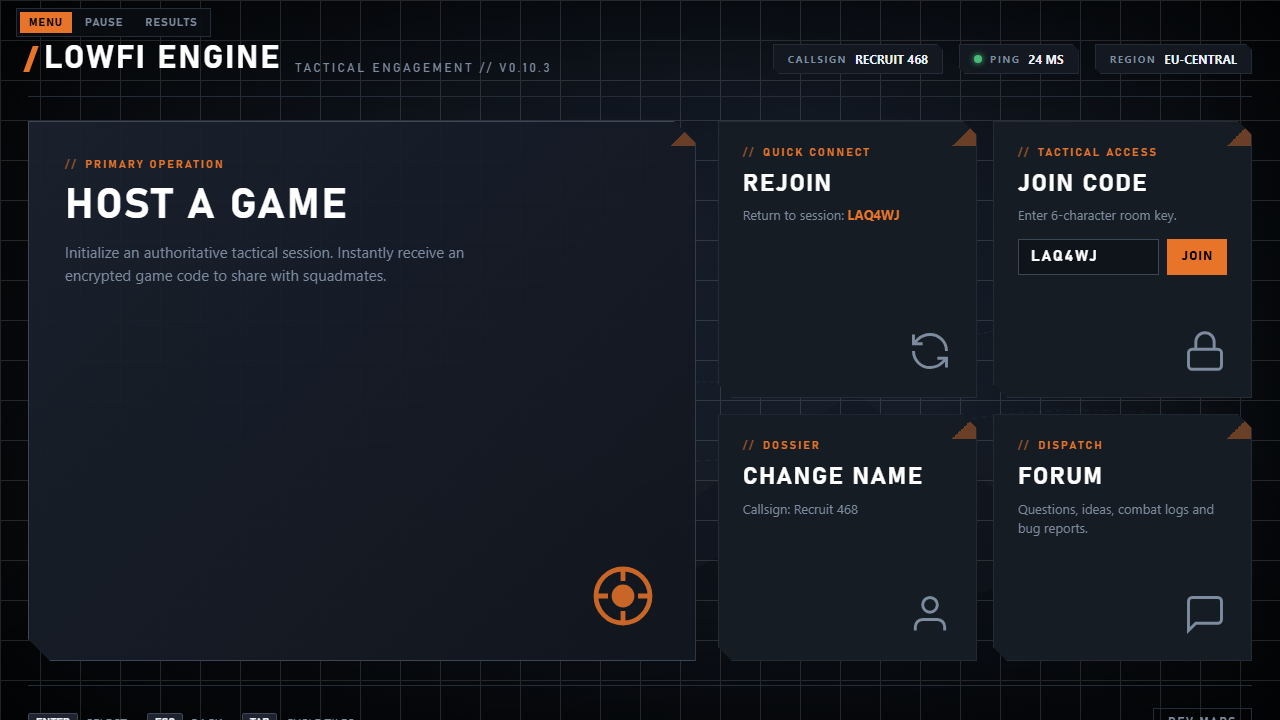
An archived capture of the real game UI after the V9 implementation. This is the
0.11.3.1-era interface family, still evolving in experimental development.
Reading the archive
The images are genuine archived screenshots, resized for this page. Prototype titles and
controls remain as they were. Exact capture builds were not recorded for every image, so
the illustrations are not presented as pixel-exact snapshots of a particular release.
Older images sometimes call the game “Lowfi Engine” or “GAME TITLE”. The game received the
name Nexus in 0.11.0. Lowfi Engine remains the engine it runs on.